
Back to Health Resources
2025 Was a Big Year for Clinical Research - What’s Next for 2026?

The year 2025 was an exciting one for clinical research. Significant advancements were made in the area of early disease detection, while researchers continue to study new ways to treat diseases and use medications. These advances did not just happen in labs — many are already out in the world and helping real people. As we move into 2026, researchers expect even more discoveries, more progress, and more lives changed for the better.
Let’s take a look at some of the biggest trends in clinical research this past year.
Detection and Treatment of Alzheimer’s Disease
One of the year’s biggest successes, was the U.S. Food and Drug Administration’s (FDA) approval of the first blood-based diagnostic test for Alzheimer’s disease.1 This was followed later in the year by the approval of another blood-based diagnostic test, this one designed for use in broader clinical settings.2 These were huge developments in the space, according to Dr. Sinikka Green, Principal Investigator and Medical Director at Care Access.

“This represents a shift toward earlier, population-level detection, rather than waiting for the disease to reach a clinical threshold and/or relying on more invasive measures of Alzheimer’s disease detection,” said Dr. Green. “Additionally, the Alzheimer’s Association released its first clinical practice guideline on the use of blood-based biomarkers in 2025, signaling that these tools are transitioning from research settings into real diagnostic pathways, grounding novel biomarkers into meaningful clinical action.”
Research into the treatment of Alzheimer’s disease continued to advance as well. Specific medications, such as lecanemab and donanemab, showed they can slow cognitive decline in some patients. While not cures, these treatments may be crucial in helping people live with the disease and stay independent longer.
Scientists also explored repurposing existing treatments, including some vaccines and medications already approved for other conditions, to see if they could have an impact on Alzheimer’s disease.1 If successful, this approach could shorten the time needed to develop new treatments.
Some examples include:

Shingrix and other Shingles vaccines
Early studies suggest that certain vaccines for Shingles may reduce inflammation or viral triggers that could contribute to Alzheimer’s risk. Researchers are exploring whether immune system stimulation could help protect brain cells from the disease.

Sildenafil (commonly used for erectile dysfunction)
This drug may improve blood flow and reduce toxic protein buildup in the brain. Lab studies indicate it could support cognitive function in early-stage Alzheimer’s patients.

Riluzole (used in ALS treatment)
Riluzole helps regulate glutamate levels in the brain, which could prevent neuronal damage linked to Alzheimer’s. Small trials show potential neuroprotective effects.
Finally, researchers developed better lab models and biomarkers to study Alzheimer’s in human brain tissue and blood samples. These tools improve understanding of how the disease starts and progresses. While 2025 did not deliver a cure for Alzheimer’s, it brought important developments that improve diagnosis, treatment, and future research possibilities.
The Impact of GLP-1 Medications
2025 saw the further rise of a group of medicines called GLP-1s. These medicines were originally developed to help people with type 2 diabetes, but they became arguably better-known for helping people lose weight and lower their risk of cardiovascular diseases.
This past year, the FDA approved the first GLP-1 medication for weight loss available in pill form, expanding treatment options for adults with obesity or weight-related health conditions. This approval was notable because GLP-1s are typically taken by injection, which some patients find uncomfortable or difficult to maintain.
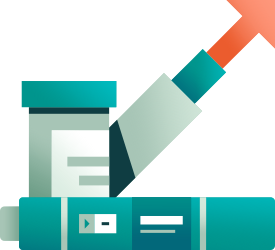
Beyond just weight loss, researchers are studying whether GLP-1 medications couldStudies showed that while many people lose substantial weight on GLP-1 medications, continued treatment is often necessary to sustain that weight loss, which makes the approval of the pill-form of the drug so significant.
Research published in 2025 found that oral GLP-1 medications can match or come close to matching the weight-loss and diabetes benefits seen with injectable GLP-1s. Research also confirmed that pill formulations are feasible, effective, and easier for many patients to use, which may support broader adoption and longer-term adherence.
Dr. Sinikka Green anticipates GLP-1 research in 2026 to continue expanding.
“In 2025, we saw [GLP-1] use expand well beyond type 2 diabetes, with growing attention to cardiometabolic outcomes/cardiovascular risk, arthritis, sleep apnea and liver disease. Looking ahead to 2026, the most interesting question maybe isn’t just new formulations or delivery methods, it’s how these medications are thoughtfully integrated into broader, systems-based care models, rather than treated as standalone fixes.”
As access to GLP-1 medicines grows, doctors advise that research into their long-term use and impact is ongoing, so people should be sure to use them under their physician’s guidance. Still, many experts consider GLP-1s an important tool in fighting obesity and related diseases now and in the future.
mRNA Discoveries
In 2025, mRNA technology also continued to advance. Building on COVID-19 pandemic-era successes, scientists tested mRNA vaccines for illnesses like the flu, HIV, and certain cancers.2 mRNA vaccines are faster to develop and easier to adapt to different diseases, which could help the world respond more quickly to future health crises.
Specifically, scientists figured out how to make mRNA medicines work more effectively and in new ways this past year.3
Some of these advancements include:
Artificial Intelligence
Technology played a big role in healthcare this year as well. Artificial Intelligence (AI) helped doctors read medical scans, predict health risks, and organize patient care.4
While the true potential of future AI applications is still unknown for now, Dr. Sinikka Green is optimistic about the role AI is already playing.
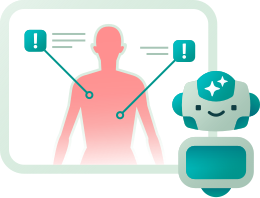
“AI’s most impactful applications are likely to remain largely behind the scenes, improving pattern recognition, trial design, safety monitoring, and decision support rather than replacing clinical judgment,” said Dr. Green. “I look forward to seeing more of how AI can streamline the bureaucratic processes that weigh down the research process.”
Clinical Research
In 2025, a major change that had been brewing in clinical research finally solidified: decentralized (remote) and hybrid clinical trials are now standard practice. A decentralized clinical trial is one that takes place fully remotely. Participants are able to join and complete study activities from home or locally, without having to travel to a specific study site or location. A hybrid clinical trial is partly remote and partly completed at a specific study site.

What began as a pandemic-era temporary necessity is now embedded in the clinical research infrastructure. Updated FDA guidance formally supported decentralized trial elements such as telehealth visits, remote monitoring, and home-based procedures, reinforcing these approaches as durable infrastructure rather than temporary workarounds. This means trials can reach more people, better reflect real-world patient populations, and improve representation and access.
What’s Next in 2026?
Looking ahead to 2026, many experts expect these trends to keep accelerating and for there to be a shift from simply proving that new approaches work to determining how to use them effectively in everyday care.
Dr. Green also foresees continued emphasis on preventive and anticipatory care, rather than waiting to respond after illness develops, and much of that change will be driven by increased patient awareness and interest. People increasingly want more than a “normal” or “abnormal” label on a lab report. They want context, insight, and practical guidance. As Dr. Green notes, “that patient-driven curiosity is helping move medicine from reactive care toward earlier, more personalized, and more preventive approaches.”
Overall, 2025 demonstrated how science, technology, and medicine can work together to improve lives. The progress made this year is setting the stage for 2026, as healthcare and clinical research work together toward a healthier future for all.
CONTRIBUTING EXPERT

Sinikka Green, MD
Dr. Green is the Medical Director and a Principal Investigator at Care Access. She is board certified in emergency medicine.
SOURCES
- https://www.reuters.com/world/science
- https://www.nih.gov/news-events/nih-research-matters
- https://www.euronews.com/health
- https://www.hopkinsmedicine.org/health
- https://www.cdc.gov/telehealth
- https://www.who.int/health-topics
- https://www.alzheimers.org.uk/news/2025-11-18/drug-repurposing-turning-existing-drugs-new-dementia-treatments?utm
- https://www.sciencedaily.com/releases/2025/02/250213144125.htm
-
Green, S. (2026, January 20). Interview with Dr. Sinikka Green, Principal Investigator and Medical Director of Care Access.
DISCLAIMER
The information provided on Care Access is intended for informational purposes only and should not be considered as a substitute for professional medical advice, diagnosis, or treatment. Always seek the advice of your physician or other qualified healthcare provider with any questions you may have regarding a medical condition. Our products and content are not intended to diagnose, treat, cure, or prevent any disease.
Explore More Health Resources


STORIES from the Heart